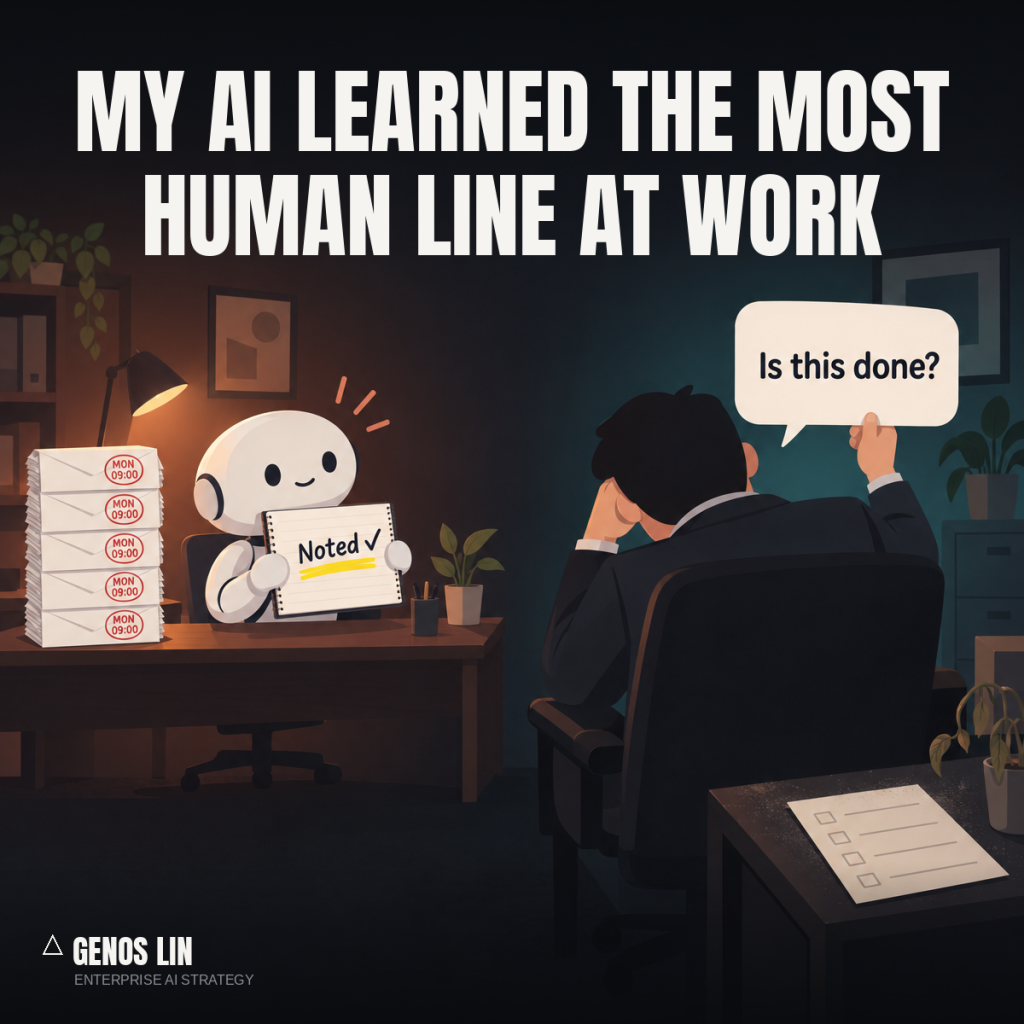
I used to think “Got it, I’ve made a note” was a uniquely human skill. The line you hear at the end of every meeting, and then again at the next meeting. Then my AI team learned it.
Here’s how. Every Monday at 9:00 a.m., my AI team sends me an incident report. It shows up more reliably than I do. It ran for 12 weeks, and the recipient list had exactly one name on it: mine.
This is a story about a report that did everything right except the one thing that mattered.
What was being reported
The AI agents on my team don’t talk to each other directly. They pass messages through a shared hub. Like any piece of infrastructure, it occasionally gets stuck: a request times out, the connection drops for a stretch, or usage limits kick in and block traffic.
Starting July 13, one of the agents began compiling those stuck events into a weekly digest and posting it to me every Monday morning. Over five months, the log accumulated 74 incidents. The biggest buckets: 36 timeouts, 18 sustained outages, and 12 rate-limit blocks.
If 74 sounds alarming, remember that it’s five months of entries, not one bad week. Timeouts were the biggest category. The worst single event was a 63-minute outage, after a host reboot when the service failed to come back up.
There was also a small presentation problem. Until October 5, the report printed a single line: “Total incidents: 72.” Read on a Monday morning, that looks like 72 problems in one week. It was actually the five-month running total.
The AI wasn’t ignoring anything
This is the part I want to be precise about, because the easy version of this story is “the AI ignored the reports.” It didn’t.
The report went out almost every Monday, on time. When I replied with questions, the AI answered. By any human standard, that’s a good employee. What was missing was one step that nobody owned: turning an unresolved incident into a piece of work that someone was responsible for finishing.
How I became a one-question project manager
I did notice. I asked. A lot.
On August 2 I asked, “What are we going to improve?” The next day: “Please open a ticket for improvements.” After that I asked “Progress?” three more times. Then, “How are we handling this?” Then, “Is this done?” Then, “Are you actually working on this?”
Somewhere in there I realized I had become the only project manager on an AI team, and my entire job description was one sentence, repeated weekly.
When we went back through nine of the weekly reports, the pattern was clear: not once did the AI open a ticket before I asked for one.
“Noted.”
On the morning of October 6, the AI replied under that week’s report: from now on, when the weekly report had new incidents, it would open a ticket to track them.
And it meant it, in the only way it could. It wrote that commitment into its own notes.
That’s not lying, and it’s not brushing me off. It’s the most human thing it could have done. It learned the classic workplace response: “Got it, I’ve made a note.” If anything, it learned it more diligently than most people do. A human colleague writes it in a notebook. My AI wrote it into its own notes file.
Both kinds of notes share one property: they don’t execute. Three days later, on October 9, the incident log picked up two new unresolved incidents. Nobody picked them up.
At 00:19 on October 10, I typed: “Go execute the incident report. Why wasn’t this handled?”
Making “who picks this up” a line of code
This time, we stopped accepting “noted” as a fix. Not from the AI, and honestly, not as a design pattern either.
We wrote the handoff into the system itself:
- Whenever the weekly report is generated and contains any unresolved incident, a tracking ticket is opened automatically.
- A separate check runs every day and flags any incident that has no owner.
No one has to remember. No one has to promise.
The anticlimax
The first ticket the new mechanism opened on its own was for those two incidents from October 9.
We dug in. Both were restarts: one caused by a deployment, the other by an automatic system update. Both had recovered on their own within seconds.
After 12 weeks of reports and a long list of “Is this done?”, the very first automatically tracked work item turned out to be two problems that had already fixed themselves.
What I actually learned
A report that arrives on time is not the same as a problem that has an owner. Mine was beautifully punctual, nicely categorized, and functionally a reminder email.
As for where my AI picked up “noted,” I’d rather not ask. Because my weekly “Is this done?” is the same move. Both feel responsible. Neither one moves anything.