I gave a talk this week on whether small and mid-sized businesses should adopt AI. I walked in planning to give an answer. I walked out arguing with myself.
Because there isn’t one answer. There are three, and they don’t get along. Since the talk ended, three voices have been running a debate in my head — and I’ve come to think the disagreement between them is more useful than any clean conclusion I could have delivered from the stage.
Let me introduce them.
The first voice: move now, or you’re already dead
This is the voice of urgency. It points at the pace of the models — every quarter more capable, every quarter cheaper — and it argues that the gap between the companies that adopt and the ones that hesitate compounds daily. Wait for certainty, and certainty will arrive in the shape of a competitor who didn’t wait. Get on the boat first. Sort out the seating later.
I find this voice hard to dismiss. On the raw technology curve, it’s simply right.
The second voice: wait — what are you losing?
This is the humanist. It isn’t afraid of falling behind. It’s afraid of winning the wrong race. It asks whether a business that automates every judgment, every conversation, every decision is still a business anyone chose to build — or just a faster version of something nobody feels connected to anymore. Efficiency, it warns, is not the same thing as meaning. A company that optimizes away everything human eventually optimizes away the reason it existed.
This voice makes me uncomfortable, because it usually speaks up at the exact moment the spreadsheet says everything is going well.
The third voice: fine, adopt — but who are you building the moat for?
This is the strategist, and it’s the coldest of the three. It doesn’t care about your enthusiasm or your anxiety. It asks one question: when you wire someone else’s AI into the center of your business, are you arming yourself, or turning yourself into a data farm for a company far larger than you? Use the generic tool the generic way, and you’re not building an advantage. You’re renting the average, and paying for the privilege of training your own replacement.
I find this voice the most strategically honest, and the least comfortable to repeat to a room that just wants a tool recommendation.
Where the three of them finally agree
Here’s the strange part. After enough back-and-forth, the three voices converge — not on whether to adopt, but on a single test.
If, after adopting AI, you find yourself more capable, your work more meaningful, your judgment more leveraged, then whatever you adopted was a tool. Tools are worth having. If instead you find yourself faster but more anxious, busier but more replaceable, then you didn’t adopt a tool. You adopted a goal that was never yours. I have nothing against tools. What I resist is letting the tool quietly become the point.
That reframe gave me the only decision filter I actually trust now.
The one question underneath all three voices
After you adopt AI, are you more irreplaceable — or more interchangeable?
It sounds philosophical. It’s brutally practical.
If your AI strategy is “we use a chatbot to write our marketing copy,” a competitor can reproduce it by Thursday afternoon. That isn’t a moat. It’s slow-motion self-replacement, dressed up as innovation. You adopted the exact capability everyone else is adopting, at the exact moment it stopped being a differentiator.
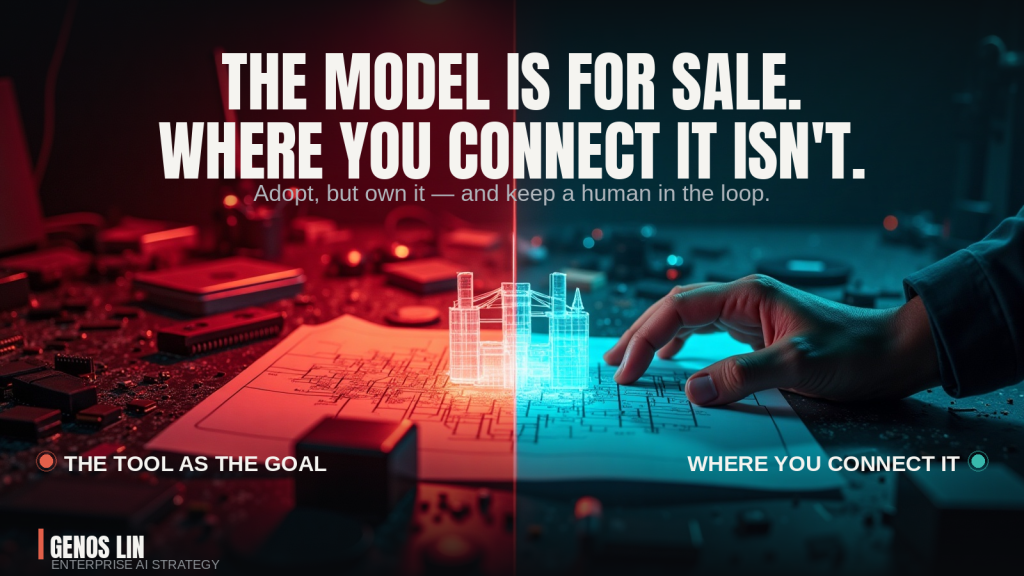
But if you use AI to wrap the things only your business has — your accumulated customer knowledge, your operational judgment, the patterns you’ve earned over years that live nowhere else — then you’ve built something that doesn’t copy. The model in the middle is a swappable component. The advantage is the proprietary logic you architect around it.
Three questions I now ask before any AI project
I turned that filter into three questions I put to a client before we build anything:
- Does this make our knowledge harder to copy — or easier? If the output is generic, so is your position.
- Who owns the output and the data it generates? If the answer is “the platform,” you’re not building an asset. You’re feeding one.
- What is the exit cost? If leaving the tool means losing the capability entirely, you didn’t buy leverage. You bought dependency.
None of these questions are about which model you license. They’re about architecture — about where, exactly, the intelligence sits relative to the things that make you you.
The reflection I actually left the talk with
The urgency voice was right: standing still is a decision, and usually a poor one. The humanist voice was right: speed without meaning is just a more expensive way to lose. The strategist was right: adoption without ownership is employment — you’re working for a company you hold no equity in.
The answer isn’t to pick one voice and silence the other two. It’s to keep all three in the room. Adopt — but keep a human in the loop. Move fast — but move on the parts that make you harder to replace, not easier. Use the tool — but never mistake it for the destination.
That’s the architecture. Everything else is just software.